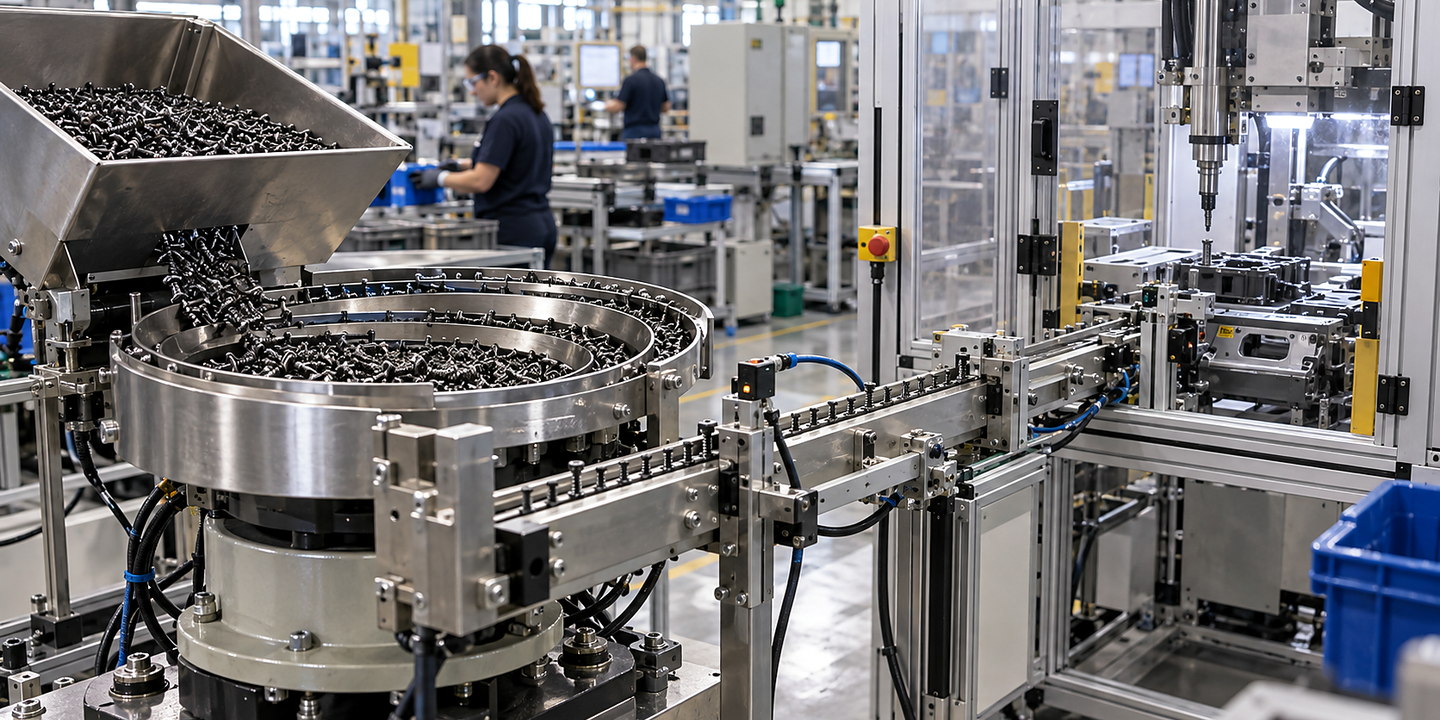
Plan mechanical, electrical, control, data, safety and operator interfaces for washer feeding systems.
In brief
Define the hand-off as one correctly presented washer accepted by the receiving process. Agree the physical position, release request, arrival confirmation and response when the station is not ready or a double or missing washer is suspected. Capture the agreed owners and checks in the specification brief.
For flexible or metered delivery involving washer separation and orientation, define every physical connection, signal, responsibility, check and fallback before installation.
On the production floor
Connect equipment, controls and people into one reliable process — Washer Feeding Systems
Plan washer feeding systems around real component variation, bulk condition, orientation, usable delivery rate and the downstream interface. Discuss representative part trials with Sorting Solutions. Your integration review should connect bulk condition and replenishment method, required orientation and delivery rate and the people who run the process.
Six areas to coordinate for washer feeding systems
Mechanical
Confirm the receiving-tool geometry, release position and orientation, with access for setup and the approved recovery method. Trial the actual interface so separation at the feeder is not mistaken for successful placement at the next process.
Electrical
For Washer Feeding Systems, list the supplies, isolation, protective devices, panels and cable routes required by the proposed installation.
Controls
Agree which station requests a washer, when release is permitted and how the receiving process confirms the result. Document the response to no arrival, a possible double washer or downstream interruption, including controlled restart responsibilities.
Safety
Review risk controls, stop behaviour, access, reset and the checks needed around required orientation and delivery rate.
Data
Where records are required, identify the washer variant and setup, the delivery result and any double, missing-part or recovery event. Agree who uses the records and how an unresolved result remains distinguishable from an accepted delivery.
Your team
Assign normal replenishment, setup changes, inspection and approved clearance or recovery tasks. Identify who reviews damage or repeated double/missing-part events and which checks are required before production resumes.
How the work comes together
Plan fault recovery for bulk presentation using washer separation and orientation as carefully as normal running
For Washer Feeding Systems, your team can review each stage before the complete installation is put into routine use.
01
Review Representative Production Components
Share representative production components and the downstream interface, including the normal range for component geometry and variation for washer separation & orientation and the difficult surface, fragility and entanglement behaviour cases.
02
Trial Separation, Orientation and Presentation
Compare suitable methods and use focused trials to show how each option performs against bulk condition and replenishment method.
03
Develop Tooling, Controls and the Downstream Interface
Connect the equipment to your line, services and controls while resolving required orientation and delivery rate for day-to-day operation.
04
Challenge Delivery, Replenishment, Jams and Recovery
Confirm escapement and downstream pick interface, then complete and record jam, damage and recovery acceptance checks before your operating team takes over.
For your application: check bulk condition and replenishment method, required orientation and delivery rate, escapement and downstream pick interface, and jam, damage and recovery acceptance checks as part of the complete line trial.
Important limits
Line connections can change the approach for Washer Feeding Systems
Sample trials must include normal, marginal and supplier-variant components.
Quoted feeder output is not the same as usable delivery at the downstream process.
Fragile, flexible, magnetic or entangling parts may need a different presentation method.